The era of prompting is over.
loopy is a terminal meta-agent that watches how you work, finds the patterns, and writes the loops so you don't have to.
curl -fsSL https://raw.githubusercontent.com/secretbuilds/loopy/main/install.sh | bash4XRCJkkqYZXhMLu2chJ2Sdw3wR6dYZTu9aTS222Kpumpwatching 5 sessions · daemon ✓ · spend 0/10000
all quiet — your loops have it covered
The best engineers stopped prompting.
I don't prompt Claude anymore. I have loops running that prompt Claude and figure out what to do. My job is to write loops.
Stop prompting coding agents. Start designing the loops that prompt them.
The shift to loop engineering is real — but finding your patterns takes observation, pattern recognition, and time you don't have. loopy does that work for you.
From session to installed loop. Automatically.
loopy runs quietly in the background. Here's the path from "I keep doing this by hand" to a running loop.
- 01
Watch
A launchd daemon notices every new Claude Code session transcript the moment it lands.
step 01[watcher] session claude-code started · 13:28 - 02
Digest
Each session is compressed and redacted to a compact text digest — secrets stripped before anything leaves your disk.
step 02[digester] session → digest · 🔒 redacted: 4 secrets - 03
Propose
Your own claude -p reads the digests, spots work you keep doing by hand, and lands a ready-to-install loop in your inbox.
step 03▶ auto-lint-fix impact: high · confidence 0.9 - 04
Install
Approve the ones that make sense. loopy writes the loop.md, trigger, and manifest — wired into Claude Code or Codex.
step 04~/.loopy/loops/auto-lint-fix/├ loop.md├ trigger.json└ manifest.json
Most Claude Code users leave 40–70% on the table.
loopy finds it.
Repetitive overhead
Token burn on repeated patterns
Automatable patterns found / month
A single well-chosen loop replaces 50–200 manual prompts per month.
Early estimates from initial use — your mileage will vary.
One command. Your whole loop operation.
$ loopy
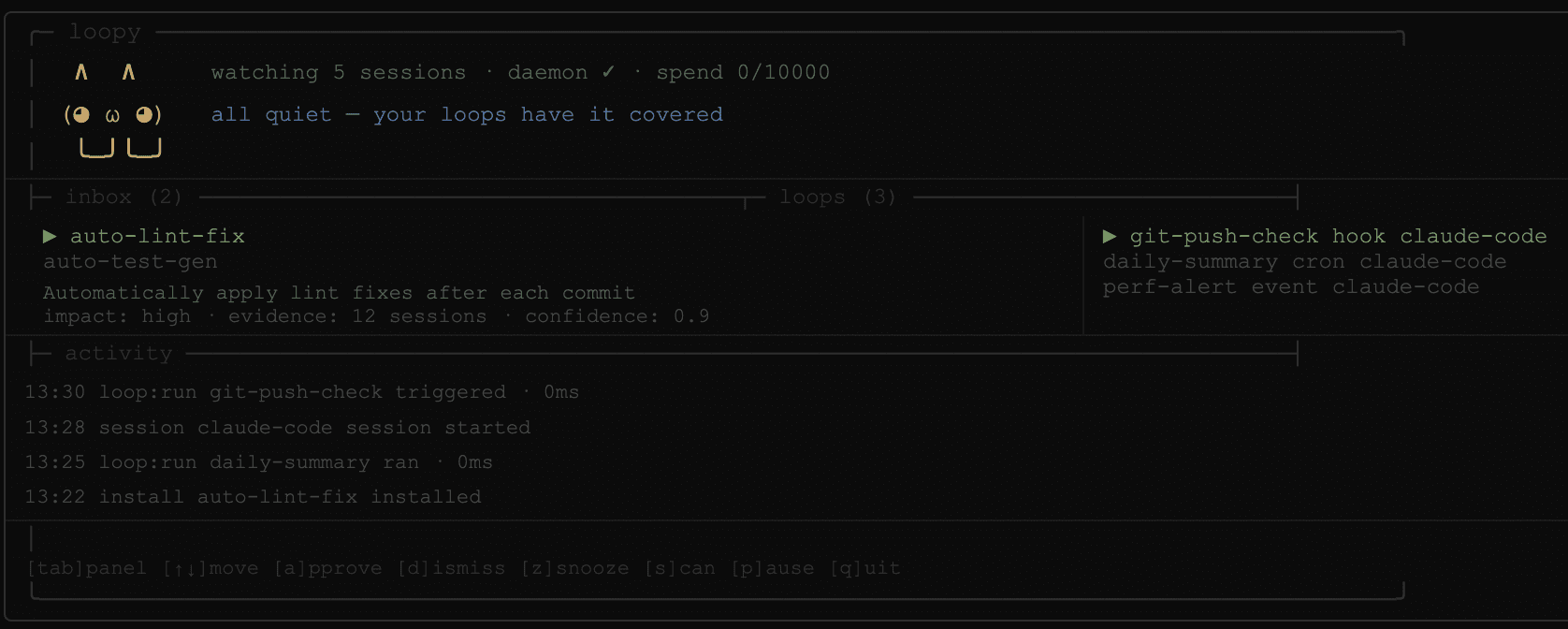
Review, approve, dismiss, or snooze — all from the terminal.
It never phones home.
Transcripts stay on your machine. Always. The only LLM calls go through your own claude -p binary.
- api keys, tokens, passwords, bearer tokens
- github tokens, aws keys, url credentials
- high-entropy strings that look like secrets
- your own Claude credits
- no separate service
- open source
Every session, upgraded.
The installer drops a /fable slash command into every Claude Code session — route any prompt through Claude Fable 5, inline, without switching models.
/fable make this component prettier
loopy may suggest, but it never nags. Ignore, snooze, or dismiss — a quiet tool beats a nagging one. Your inbox, your call.
Frequently asked questions.
A local meta-agent that runs in your terminal alongside Claude Code. It watches your sessions, spots work you keep doing by hand, and proposes ready-to-install automation loops. You approve; the loop runs.
Claude Code and Codex power users who want to graduate from manual prompting to loop engineering but don't know where to start — and anyone who wants to systematically cut the overhead of repetitive prompting.
No. Transcripts stay on your machine. Digests are redacted of secrets and sent only to your own claude -p process. loopy never contacts an external service.
No subscription. loopy uses your existing Claude Code CLI and your own Claude credits. No separate service, no cloud component.
A bundle at ~/.loopy/loops/<id>/: loop.md (instructions), trigger.json (schedule/hook/manual), manifest.json (evidence + every path installed), and a state/ dir. The manifest makes uninstall exact.
Yes. loopy is free and open source. Clone it, read it, contribute on GitHub.
Node ≥ 20, git, the Claude Code CLI (claude) in your PATH, and macOS. Windows/Linux daemon support is on the roadmap.
Ready to write your first loop?
curl -fsSL https://raw.githubusercontent.com/secretbuilds/loopy/main/install.sh | bashthen loopy setup